RAG vs Fine-Tuning: When to Use Which for Your Product
RAG and fine-tuning solve different problems — using the wrong one wastes money and ships a worse product. Here's a practical, founder-friendly breakdown of when to use each, with real examples from production builds.
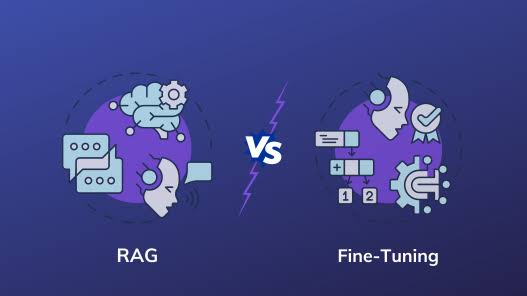
Every founder building an AI feature eventually hits the same question: should we fine-tune a model, or use RAG (Retrieval-Augmented Generation)? Most teams pick based on whichever term they heard most recently on Twitter — which is exactly how you end up overpaying for a fine-tuning job that a well-built retrieval system would have solved in a fraction of the time.
Here's the actual decision framework we use when scoping AI features for clients.
The Core Difference
RAG connects a language model to your data at query time. When a user asks something, the system retrieves relevant chunks of your knowledge base (documents, database records, product data) and feeds them to the model as context before it generates a response.
Fine-tuning changes the model's underlying behavior by training it further on examples of the input/output pattern you want. The knowledge or style gets baked into the model's weights.
They solve different problems. RAG is about giving the model access to information it doesn't have. Fine-tuning is about changing how the model behaves or communicates.
When RAG Is the Right Choice
Your data changes frequently (product catalogs, support docs, pricing, user-specific records)
You need the system to cite sources or stay grounded in factual, verifiable information
You're building a chatbot, internal search tool, or Q&A system over a knowledge base
You want to avoid hallucination on domain-specific facts
You need this shipped fast — RAG systems are faster to build and iterate on than a fine-tuning pipeline
Most SaaS AI features — support bots, document search, internal copilots — are RAG problems, not fine-tuning problems. This is also why RAG is usually the more cost-effective starting point.
When Fine-Tuning Is the Right Choice
You need a very specific tone, format, or behavior that prompting alone can't reliably produce
You're working with a narrow, repetitive task (classification, structured extraction, specific style transfer) where consistency matters more than fresh knowledge
You have a large, high-quality labeled dataset specific to your use case
Latency or cost matters enough that a smaller fine-tuned model outperforms calling a larger general model with a long context every time
Fine-tuning is less common than founders expect for MVP-stage products, mostly because it requires a dataset most early-stage companies haven't collected yet.
The Combination Most Production Systems Actually Use
In practice, the strongest systems we've built use both: a fine-tuned or well-prompted model for behavior and tone, combined with RAG for factual grounding. Think of RAG as the model's memory and fine-tuning as the model's personality and skill.
A Practical Example
For an EdTech platform, a support chatbot that needs to answer questions about course content, pricing, and policies is a RAG problem — that data changes constantly and needs to stay accurate. But a feature that generates quiz questions in a very specific pedagogical style, consistently, across thousands of generations, leans toward fine-tuning (or heavily structured prompting with few-shot examples, which is often the pragmatic middle ground before committing to a full fine-tune).
Common Mistake
The biggest mistake we see is teams jumping straight to fine-tuning because it "sounds more advanced," when a well-architected RAG pipeline with good chunking, embeddings, and retrieval logic would have solved the problem faster, cheaper, and with far less maintenance overhead.
Final Thought
Start with the simplest system that solves the actual user problem. For most AI features, that's RAG. Reach for fine-tuning only when you've hit a wall that better retrieval and prompting genuinely can't fix. If you're scoping an AI feature and aren't sure which approach fits your product, talk to our AI team — we'll map out the right architecture before you spend on the wrong one.